Lithuanian language exam
For permanent residence or Lithuanian citizenship you take the state language exam at A2 level, and since 2026 people working in services need a state language proficiency category. Here are the dates, format, scoring and registration, based on documents from the National Agency for Education (NŠA).
Checked against official sources on November 5, 2026
Which exam do you need?
For permanent residence and citizenship
The state language exam at A2 level. You register at migracija.lt, and it costs 57 €. You also take the exam on the basics of the Constitution. NŠA recommends passing the language exam first.
For work
A state language proficiency category exam: the basic category (A1) and category I (A2) are tested in one exam, which costs 52 €. You register at eksternams.nsa.smm.lt. Categories II (B1) and III (B2) have separate exams.
Since 2026, foreigners who sell goods or provide services must speak Lithuanian at least at the basic level (A1), and at A2 level after two years of living in Lithuania. This does not apply to people with temporary protection.
When is the exam for permanent residence and citizenship in 2026?
The 2027 exam dates have not been published yet
All 2026 dates
- January 16past
- March 24past
- June 4past
- August 20past
- October 7past
- November 11past
When are the basic and category I exams?
The 2027 dates have not been published yet
Register at eksternams.nsa.smm.lt (opens in a new tab)How does the exam work?
It tests reading, writing, listening and speaking. The exam takes one day at a base school (bazinė mokykla): the written part on a computer, speaking with examiners.
- Reading and writingShort texts from everyday life: notices and signs, instructions, personal letters, short newspaper pieces. You fill in a simple form and write a short connected text.
- ListeningPhone calls, announcements, answering machine messages. You need to understand and note down simple facts.
- SpeakingA conversation with an examiner in three situations: getting acquainted, a picture with questions on its topic, a notice and a card with prompt words. Details below.
How does the speaking part go?
There are two people in the room. The interlocutor talks with you, while the assessor listens and gives the points without joining in. Speaking consists of three situations and takes about 15 minutes.
1. Getting acquainted
up to 5 minutes
The interlocutor asks about you, as people do when they first meet: your name, where you are from, where you work, whether you have brothers and sisters, what you do in your free time and at weekends, what you are wearing today. If you get stuck, you get a helping question.
Sample questions
- Koks jūsų vardas?
- Iš kur jūs esate?
- Kur jūs dirbate?
- Ką veikiate laisvalaikiu?
This checks whether you can answer simple everyday questions about yourself, your day, your interests and plans.
Words for the topic “About me”2. A picture and questions on its topic
5–6 minutes plus a minute to prepare
Task A. You get a picture of an ordinary everyday situation, for example people in a shop or travellers at a station. You describe it.
Task B. Then the interlocutor asks 5 questions on the same topic. If the picture shows a station, they are about travel: when you usually take a holiday, how you get there, where you like to spend it. After that you ask the interlocutor 5 questions on the topic. They are not answered.
Sample questions
- Kada jūs paprastai atostogaujate?
- Kuo važiuojate atostogauti?
- Kur mėgstate atostogauti?
This checks whether you can describe an everyday situation, answer questions and ask your own on one of the 12 programme topics.
The 12 programme topics3. A notice and a card with prompt words
4–5 minutes plus a minute to prepare
Task A. You get a card with a notice, for example about Italian language courses. The interlocutor asks 5 questions, and you find the answers in the notice: when the course starts, how much it costs, how to sign up.
Task B. You get a new card with only a heading and prompt words. For example, NUOMA (rent) with vieta, laikas, telefonas, durų kodas, aukštas (place, time, phone, door code, floor). Now you ask the interlocutor 5 questions to find out what is missing, and this time you get answers.
Sample questions
- Kada prasideda kursai?
- Kiek kainuoja kursai?
- Kaip užsiregistruoti?
This checks whether you understand short notices and timetables and can ask about what you do not know.
Notices and dialogues in the Reading section
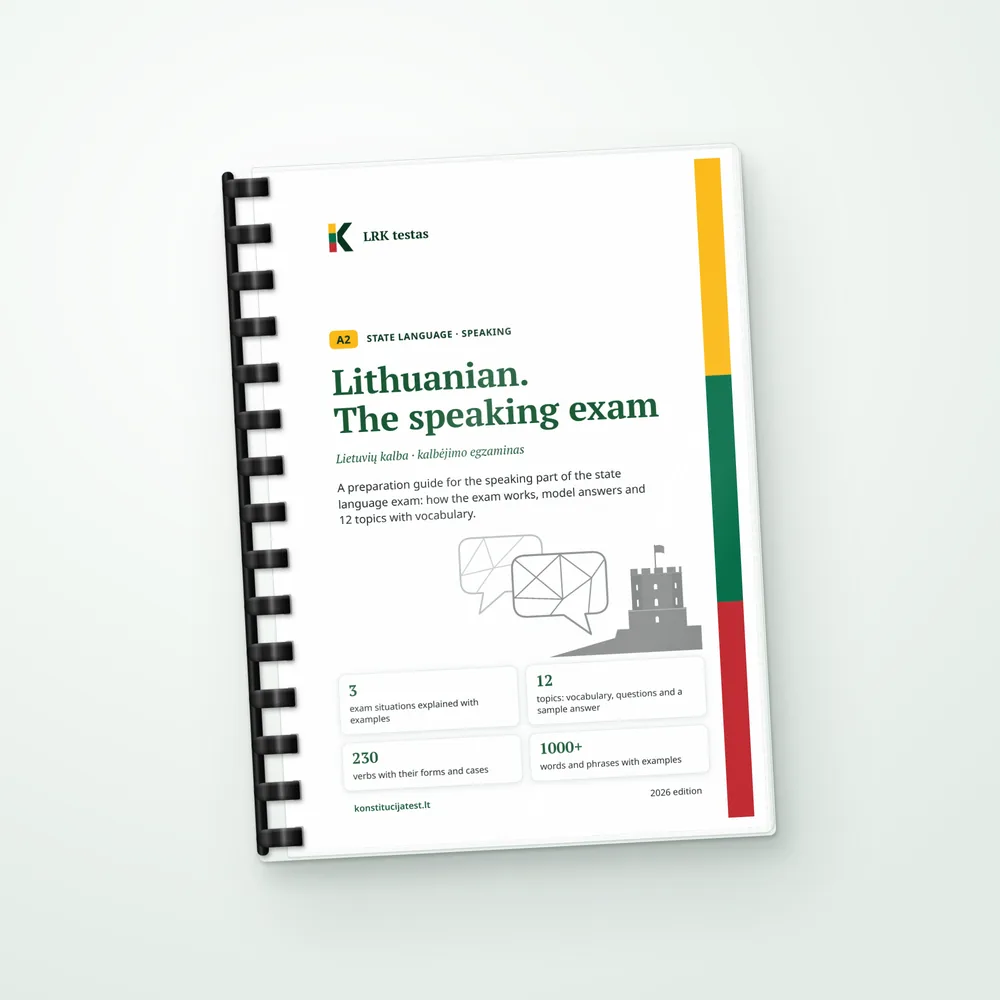 Printed guide to the speaking examThe three exam situations explained, model answers and 12 topics with vocabulary. Delivered to an Omniva parcel locker.+10 days of Premium as a giftOrder the bookfrom €19.90
How is it scored?
Each part must be passed at A2 level. In reading and writing and in listening, that means getting at least 60% of the A1 tasks and at least 60% of the A2 tasks right.
Speaking is scored out of 10 points. The assessor gives 0 to 3 points for each of the three situations, and the interlocutor adds up to 1 point for the whole conversation. A2 needs at least 6 points, with at least 5 of them coming from two of the three situations together.
If even one part is passed only at A1, the exam result is A1. For work that is the basic category, but no A1 certificate is issued for permanent residence. If any part is failed, the whole exam is failed.
What do the examiners look at in speaking?
- Whether communication works: you find your way in an everyday situation, get the information you need and answer so that the other person understands you.
- Grammar forms and vocabulary.
- Pronunciation.
- Independence: whether you manage the task without help.
A situation earns 3 points when you:
- use both simple forms (the usual tenses and cases) and more complex ones (the conditional, reflexive verbs)
- understand and use A2 vocabulary
- give full answers, not two or three words
- finish the task in the time given
- find a way round a missing word: say it differently, explain in other words
- ask for help no more than once
- make only a couple of small mistakes in grammar, vocabulary or pronunciation that do not get in the way
- understand everything and are understood
What topics come up?
Topics from the exam programme. The tasks check whether you can manage everyday situations: ask the way, see a doctor, go shopping, talk about yourself.
- You: name, address, family, character30 words
- Home and housing30 words
- Nature, town and weather32 words
- Daily life and work30 words
- Free time, sport and holidays30 words
- Travel and transport32 words
- People, government and public life27 words
- Health and medical care31 words
- Studies31 words
- Shopping, clothes and prices29 words
- Food and cafés34 words
- Services: post, bank, police, clinic29 words
How do you register and what does it cost?
For permanent residence and citizenship you register at migracija.lt (MIGRIS), which needs a Lithuanian personal code. Choose a base school in your municipality (or the nearest other one if it is full), press “Atlikti mokėjimą” and pay 57 €. Candidates who have not paid are left off the list.
For work you register at eksternams.nsa.smm.lt, and the system tells you how to pay once you have registered. The basic and category I exam costs 52 € and is taken in your own municipality. Category II and III exams are held only in Vilnius, Kaunas, Klaipėda, Panevėžys, Šiauliai, Utena, Alytus and Marijampolė.
Bring an identity document and arrive 30 minutes early.
When are the results?
Within 15 working days at the latest. For the permanent residence and citizenship exam you find out by phoning the base school; a category exam result appears in your eksternams.nsa.smm.lt account. NŠA issues the certificate and the school hands it out.
How to prepare?
NŠA publishes sample tests. And this site has a Lithuanian course built on the programme topics: a lesson a day, words, grammar, reading and dialogues.
NŠA sample tests (opens in a new tab)Open the Lithuanian courseAfter the language: the Constitution exam
Permanent residence and citizenship also require the exam on the basics of the Constitution. Practise with questions in Lithuanian, as in the exam.
Sources
- NŠA exam schedule for 2026 (opens in a new tab)
- NŠA memo: exams for permanent residence and citizenship (opens in a new tab)
- NŠA memo: category exams (opens in a new tab)
- State language exam programme (opens in a new tab)
- Scoring of the basic and category I exam (opens in a new tab)
- Category exams and fees: eksternams.nsa.smm.lt (opens in a new tab)
- NŠA sample tests (opens in a new tab)
- LRT: language rules for service workers (opens in a new tab)
This site is not affiliated with NŠA or the Migration Department. If the rules change, the official sources apply.